Full Fibre vs Superfast Broadband: What’s the Difference?
The full fibre vs superfast debate confuses a lot of UK households, and broadband marketing deserves most of the blame. For years, providers sold packages called “fibre broadband” that contained very little actual fibre, running over the same copper phone lines as the ADSL connections of the early 2000s. Meanwhile “full fibre”, “FTTP”, “gigabit broadband”, and “ultrafast” all get thrown around as if they mean the same thing. They do not.
This guide explains exactly what each term means, how the two technologies work under the bonnet, where they genuinely differ in day-to-day use, and how to decide which one your household needs. By the end, you will know whether paying extra for full fibre is worth it for you, or whether superfast is perfectly fine.
What Is Superfast Broadband?
Superfast broadband is Ofcom’s official term for any fixed connection with download speeds of 30Mbps or more. That is a performance label, not a technology label, and the distinction matters enormously.
Most superfast connections in the UK still run on fibre-to-the-cabinet (FTTC) technology. Fibre optic cable runs from the exchange to the green street cabinet, and the final leg from the cabinet to your home travels over the old copper telephone line. Typical packages advertise speeds between 30 and 80Mbps, with 67Mbps being the most common headline figure.
The copper tail is the weak point. Copper signals degrade with distance, so a home 100 metres from the cabinet might get the full 67Mbps while a home a kilometre away gets 25Mbps from the same package. Copper is also sensitive to interference, weather, and the general electrical noise of a busy neighbourhood. Speeds fluctuate, evening congestion bites harder, and upload speeds are modest, usually around 10 to 20Mbps.
Superfast served Britain well for a decade. It comfortably handles HD streaming, browsing, and home working for one or two people. But it is now a legacy technology in slow retreat: Openreach and the altnets are replacing it street by street, and Ofcom’s data shows the country steadily migrating to full fibre as it becomes available.
What Is Full Fibre Broadband?
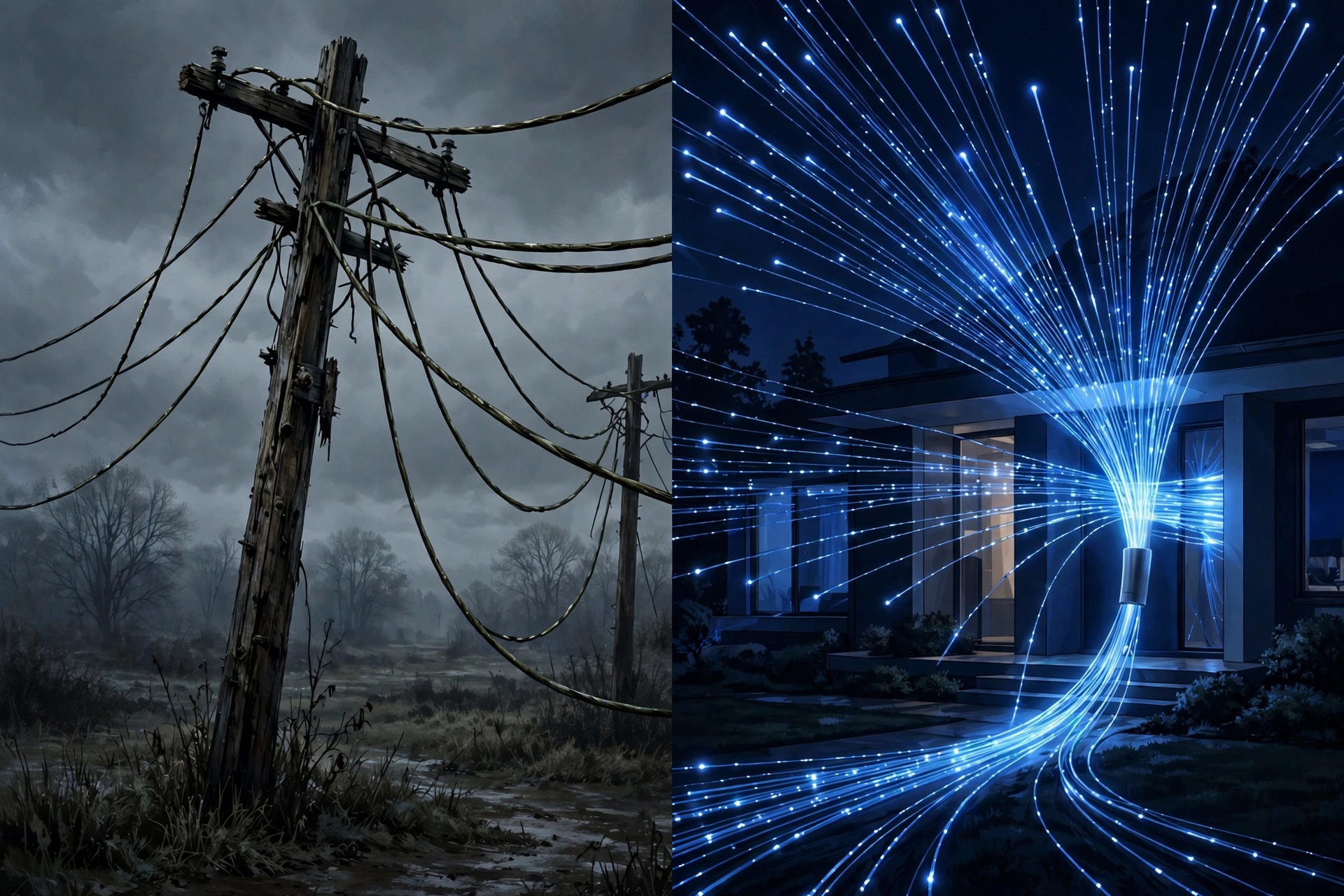
Full fibre, technically fibre-to-the-premises (FTTP), runs a glass fibre strand all the way from the exchange directly into your home. There is no copper anywhere in the chain. Because data travels as light, the signal barely weakens over distance, so a home five kilometres from the exchange gets the same speed as one next door to it.
Packages typically start at 150Mbps and scale to 900Mbps or a full gigabit, with some providers offering even faster tiers. But the headline speeds undersell the real story. Full fibre lines are dramatically more consistent: peak-time slowdowns are far smaller, latency is lower, and the connection is more resilient in bad weather. Upload speeds are healthier too, often 20 to 100Mbps depending on the tier, and some altnet providers offer fully symmetrical speeds where upload matches download.
Installation is the one genuine hassle. Because the fibre must physically reach your home, an engineer visit is usually required, and in flats or listed buildings the building management may need to grant permission. Once installed, though, full fibre is largely fit and forget. Ofcom’s Spring 2026 figures put full fibre availability at 82% of UK homes, around 24.9 million properties, with take-up at about 47% where available. In other words, millions of households are sitting on streets where full fibre is ready and waiting.
Full Fibre vs Superfast: Head-to-Head
Here is the honest comparison across the factors that actually affect your daily experience:
| Factor | Superfast (FTTC) | Full fibre (FTTP) |
|---|---|---|
| Typical download speeds | 30 to 80Mbps | 150Mbps to 1Gbps+ |
| Typical upload speeds | 10 to 20Mbps | 20 to 100Mbps (sometimes symmetrical) |
| Speed at peak times | Noticeable slowdown common | Very little slowdown |
| Effect of distance from cabinet | Large: speed drops with distance | None: speed is the same everywhere |
| Reliability | Good, but copper faults happen | Excellent: fewer faults, weather resistant |
| Latency for gaming and calls | Higher and more variable | Lower and more stable |
| Future-proofing | End of the line: being phased out | Headroom for decades |
| Installation | Usually self-install, quick | Engineer visit usually needed |
| Availability (2026) | Near universal | 82% of homes and climbing |
Notice what the table does not say: that superfast is unusable. For a couple who stream in HD and browse the web, a stable 50Mbps FTTC line is genuinely fine. The full fibre vs superfast question only becomes decisive as household demand grows: multiple 4K streams, competitive gaming, heavy home working, or a family of five all online at once.
Why the Last Few Hundred Metres Matter Most
Here is the technical explanation in plain English. Every broadband connection has two parts: the journey from the internet to your street, and the journey from your street to your sofa. The first part has been fibre for years on every technology. The difference between superfast and full fibre is entirely about that final stretch.
On FTTC, your data travels as light to the cabinet, then gets converted to electrical signals for the copper run to your home. That conversion and the copper itself introduce losses, interference, and variability. The longer the copper, the worse it gets. This is why two houses on the same street can get wildly different speeds on identical packages.
On FTTP, the light never stops. A passive optical network splits the fibre signal to serve multiple homes, but nothing in the chain depends on Victorian-era copper or the distance to a cabinet. The result is a connection whose performance is predictable to within a few percent, day and night.
This predictability is the single biggest quality-of-life difference. Superfast users learn their line’s quirks: fine at 11am, sluggish at 8pm, flaky when it rains. Full fibre users mostly stop thinking about their broadband at all. When providers talk about full fibre being “more reliable”, this is what they mean, and independent fault data backs it up.
Upload Speeds: The Difference Nobody Advertises
Broadband adverts shout about downloads and whisper about uploads, which is a shame because uploads increasingly define how a connection feels. Video calls, cloud photo backups, posting videos, online gaming, and working with files on a company server all lean on upload capacity.
A typical superfast package offers around 10 to 20Mbps up. That handles one video call comfortably. Add a teenager livestreaming gameplay while a cloud backup churns through the family photo library, and the connection starts to stutter. Downloads may still test at full speed while everything interactive feels sluggish, which is deeply confusing until you realise the upload lane is jammed.
Full fibre changes the arithmetic. Even entry-level 150Mbps tiers commonly include 30Mbps or more of upload, and higher tiers or symmetrical altnet packages remove the constraint entirely. Households where two adults work from home will feel this difference every single working day, not just in the evenings.
Can You Actually Get Full Fibre? Checking Availability
National statistics are encouraging, but broadband is bought one address at a time. Full fibre availability varies enormously: some cities are near fully covered while some villages and even some urban streets are still waiting. Two facts from Ofcom’s latest data are worth knowing:
- 82% of homes can order full fibre as of January 2026, and the build is adding over a million homes every six months. Coverage is on course to keep climbing sharply through 2028.
- Take-up lags badly. Only about 47% of premises that can get full fibre have taken it. Around 14 million UK homes have full fibre in their street and have never ordered it, often because nobody told them it arrived.
To check your address, use the availability checkers on the Openreach and CityFibre websites, plus individual providers, since different networks cover different streets. Enter your postcode and look specifically for FTTP or full fibre products. If only FTTC-based “fibre” packages appear, full fibre has not reached you yet.
If full fibre is available, there is rarely a reason to stay on superfast. Providers price full fibre competitively to win migrations, and in many cases a 150Mbps full fibre package costs the same as or less than an older 67Mbps superfast deal. The switch usually needs one engineer visit, and Ofcom’s One Touch Switch process means your new provider coordinates the changeover.
Should You Upgrade? Who Benefits Most from Full Fibre
The upgrade decision comes down to your household, not the marketing. Full fibre is clearly worth it if any of these describe you:
- Multiple simultaneous streamers. Two or more 4K streams plus everything else a family does online will expose the limits of a 40Mbps copper line. See our best broadband for streaming guide for the numbers.
- Home workers. Stable uploads and low latency make video calls and remote desktops dramatically better.
- Gamers. Lower, steadier latency matters more than raw download speed for competitive play.
- Big families. A dozen or more connected devices at peak time need the headroom and stability.
- Anyone with a flaky line. If your superfast connection drops, slows in the rain, or varies wildly by the hour, full fibre fixes the root cause.
Who can happily stay on superfast? Smaller households with modest needs, light streamers who watch in HD rather than 4K, and anyone whose line is genuinely stable at the speeds they pay for. There is no shame in a connection that works. But check the price: if full fibre costs the same at your address, take it anyway for the reliability alone.
What About the Cost Difference?
Full fibre used to carry a painful premium. That era is ending. Ofcom’s Telecoms Access Review data shows real-terms gigabit prices falling from over £60 a month in late 2021 to roughly £35 to £45 by late 2025, and competition among altnets keeps pushing entry-level full fibre tiers down. A 150Mbps full fibre package frequently undercuts legacy superfast deals from the big brands.
The honest cost comparison is not headline versus headline but total cost over the contract: introductory price, the price after month 12 or 18, setup fees, and router charges. Watch for mid-contract price rises, which remain common. And remember that switching providers when your contract ends is where the real savings live: loyalty is the most expensive broadband habit in Britain.
Full Fibre vs Superfast for Streaming, Gaming, and IPTV
For general browsing and email, you would struggle to tell the two apart. The full fibre vs superfast gap opens up with demanding, real-time uses, and streaming sits squarely in that category.
Take 4K streaming first. A single 4K film needs a sustained 20 to 25Mbps, and live IPTV is less forgiving than on-demand services because there is no deep buffer to smooth over dips. On a superfast line that tests at 55Mbps at midday but sags to 25Mbps at 9pm, a 4K stream that was perfect at lunch can start dropping to HD in the evening. On full fibre, the line that tests at 150Mbps at midday tests at 150Mbps at 9pm, so the picture never changes.
Live sport magnifies the difference further. Football and other fast-moving content punish jitter, the variation in packet arrival times, more than films do. Full fibre’s lower, steadier latency keeps the action smooth and also keeps you closer to real time: on copper-based lines, adaptive streaming often adds extra buffering delay, which is why your neighbour’s cheer sometimes arrives through the wall seconds before the goal appears on your screen.
Gaming tells a similar story. Competitive online games care about ping far more than download speed, and full fibre typically delivers single-digit millisecond latency to UK servers with far less variation than FTTC. If anyone in the house games seriously while others stream, full fibre handles the combination gracefully where superfast starts to compromise.
The practical takeaway: if your household’s heaviest use is one HD stream at a time, superfast remains adequate. If you stream in 4K, watch live sport, game online, or run several of these at once, full fibre is the meaningful upgrade. Our best broadband for streaming guide puts these numbers into a full household budget.
Frequently Asked Questions
Is full fibre the same as fibre broadband?
No, and this is the industry’s most successful piece of misdirection. “Fibre broadband” usually means fibre-to-the-cabinet, where only part of the journey uses fibre. Full fibre (FTTP) means fibre all the way to your home. Always check for the words “full fibre” or “FTTP” rather than just “fibre”.
Will full fibre make my streaming faster?
It will make it more consistent, which matters more. A stable full fibre line holds its speed through the evening peak, so 4K streams, live channels, and video calls stay smooth when a copper-based line would be struggling. Top speed matters less than steadiness for streaming.
Do I need gigabit speeds, or is 150Mbps enough?
For the vast majority of households, 150Mbps full fibre is plenty. A 4K stream needs about 20 to 25Mbps, so 150Mbps handles several simultaneous streams with room to spare. Gigabit tiers are for very heavy users, large shared houses, or people who simply want maximum headroom.
How long does full fibre installation take?
Usually a single engineer visit of a couple of hours, booked a week or two ahead. In some flats or older buildings, extra permissions or internal wiring work can add delays. Your provider will survey the property first if there is any doubt.
What happens to my landline if I switch to full fibre?
Full fibre does not use the copper phone line, so traditional landline service ends with the switch. Most providers offer a digital voice service that runs over the broadband connection instead. Note that the UK’s analogue phone network switch-off is scheduled for January 2027, so this transition is happening regardless.
The Bottom Line on Full Fibre vs Superfast
In the full fibre vs superfast contest, full fibre wins on every technical measure that matters: consistency, uploads, latency, reliability, and future-proofing. Superfast remains perfectly serviceable for lighter households, but it is a technology in managed decline, and the price gap has narrowed to the point where staying put often costs more than upgrading.
Check your address, compare the total contract cost rather than the headline speed, and if full fibre is available at a fair price, take it. Your evening streams will thank you. For more on matching your connection to your viewing habits, read our internet speed for IPTV guide and the independent Connected Nations Spring 2026 analysis (PDF).