

What Is IPTV? How Internet Protocol Television Works (2026 Guide)
The Short Answer
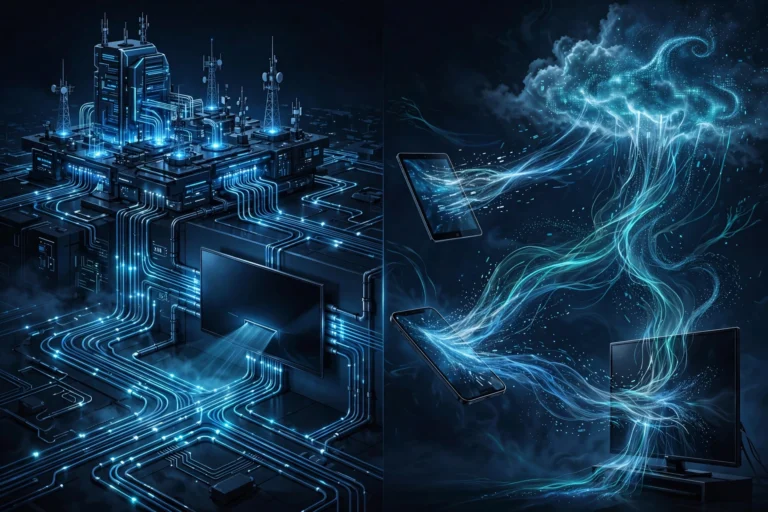
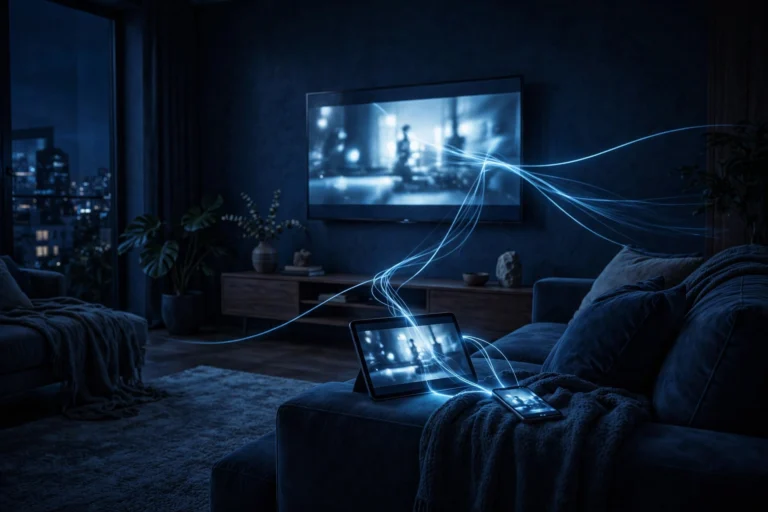
IPTV stands for Internet Protocol Television. It is television delivered over an internet connection instead of through a satellite dish, cable line or TV aerial. Live channels, sports, films and series all arrive as data over your broadband, the same way a web page or a YouTube video reaches your screen.
The International Telecommunication Union, the UN agency for telecoms standards, defines IPTV as multimedia services delivered over IP-based networks that are managed to provide quality of service, security, interactivity and reliability. In plain English: TV that travels through internet networks rather than broadcast signals.
How IPTV Actually Works
Whether you are curious about the technology or troubleshooting a stream, the journey from broadcaster to your screen follows the same five steps:
1. Content acquisition. The provider gathers live channels (via satellite feeds, fibre links or directly from broadcasters) and stores films and series for on-demand viewing.
2. Encoding and compression. Video is compressed with codecs such as H.264 or H.265 so it travels efficiently, then packaged into streams your device can play.
3. The platform in the middle. A system handles your login, your subscription rights, the channel list and the on-screen programme guide.
4. Delivery over IP. When you pick a channel, your device requests that specific stream and the network sends only that stream to you as data packets.
5. Decoding on your device. Your Firestick, Smart TV app or set-top box reassembles the packets, decodes the video and plays it, usually within seconds.
That fourth step is the key difference from traditional TV. A satellite broadcasts every channel at once and your box tunes to one. IPTV sends only what you asked for, which is why two-way features like pause, rewind and on-demand libraries are possible.
The Three Types of IPTV Content
Most IPTV services combine three formats in one subscription:
Live television. Real-time channel streaming, just like traditional broadcast. Saturday football, the evening news, live reality finales as they air.
Video on demand (VOD). A library of films and series you can start any time, the Netflix-style part of the service.
Time-shifted TV (catch-up). Programmes from the last few days available to replay without recording anything. On UK services this typically covers 7 days.
IPTV vs OTT vs Traditional TV
People often mix these up, so here is the distinction that matters:
| IPTV | OTT (Netflix, iPlayer) | Satellite/Cable (Sky, Virgin) | |
|---|---|---|---|
| How it arrives | Internet connection | Internet connection | Dish, cable line or aerial |
| Live TV | Yes, full channel lineup | Rarely (some live events) | Yes |
| On-demand library | Yes | Yes | Limited |
| Needs an engineer | No | No | Usually yes |
| Typical UK cost | From ~£10/month | £5–£18/month each | £85–£110/month |
In strict industry terms, true IPTV runs on a managed network where the provider controls quality. In everyday UK conversation, people use IPTV to mean any live-TV service streamed over the internet, which technically overlaps with OTT. For viewers, the experience is what counts: pick a channel from a guide and it plays.
What Do You Need to Watch IPTV?
Three things, and you probably have two of them already:
1. Broadband. Around 10 Mbps for smooth Full HD, 25 Mbps for 4K. Most UK fibre connections qualify comfortably.
2. A device. An Amazon Firestick, Smart TV, Android box, phone, tablet or MAG box. See our guide to the best devices for IPTV in the UK.
3. A subscription and an app. The provider gives you login details; you enter them into an IPTV player app. Setup takes about ten minutes, covered in our IPTV setup guide.
IPTV in the UK: Why It Is Booming
The UK is one of the fastest-growing IPTV markets in Europe. Three forces drive it: broadband getting faster and cheaper (full fibre now reaches around 21 million premises), pay-TV bills climbing past £100 a month, and a generation of viewers who expect television to work like every other app on their phone.
Ofcom data shows the average UK household now pulls 583GB of data a month through its broadband line. A large share of that is video. The country’s viewing habits have already moved online; IPTV is simply live television catching up with where the audience went.
Common Myths About IPTV
Myth: IPTV means piracy. The technology itself is neutral and fully legal. BBC iPlayer, ITVX and Sky’s own streaming apps all use internet protocol television technology. What matters is the provider, not the technology.
Myth: The quality is worse than Sky. On a decent broadband connection, IPTV delivers the same Full HD and 4K pictures. Quality depends on bandwidth and the provider’s servers, not on whether the signal came from a dish.
Myth: It is complicated to set up. If you can install an app on your phone, you can set up IPTV. Ten minutes, no engineer, no ladder against the wall.
Myth: It stops working when it rains. That is satellite TV. Internet television does not care about the weather, though a storm knocking out your broadband would affect everything online.
More Questions Answered
Can I record shows with IPTV?
Many player apps support recording to USB storage. Alternatively, catch-up features cover most needs without recording anything.
Does IPTV use a lot of data?
Streaming uses roughly 1GB per hour in SD, 3GB in Full HD and 7GB in 4K. On unlimited home broadband this is a non-issue; on mobile data, mind your allowance.
A Brief History of IPTV
IPTV is older than most people think. The concept emerged in the mid-1990s, when engineers first demonstrated video delivery over IP networks. Through the 2000s it grew alongside broadband adoption, and telecom operators began offering IPTV as part of triple-play bundles (internet, phone, television) over managed networks.
The real turning point came in the 2010s. Fibre broadband made high-definition streaming practical for ordinary households, and smartphones put a screen in every pocket. In Western Europe, pay IPTV subscriptions overtook pay satellite TV as early as 2015. Today, the line between IPTV and mainstream streaming has blurred so far that most viewers do not know or care which technology delivers their picture. They just expect it to work.
Multicast vs Unicast: How Streams Reach You
Two delivery methods sit behind IPTV, and understanding them explains a lot about how services behave:
Multicast sends one stream that many viewers share simultaneously. It is efficient for live channels: a million people watching the same football match do not need a million separate streams. Traditional telecom IPTV uses multicast on managed networks, which is how it guarantees quality.
Unicast sends a dedicated stream to each viewer. Every on-demand film, every catch-up programme, every viewer watching a different channel uses unicast. It is flexible but bandwidth-hungry, which is why providers invest so heavily in server capacity.
When a provider struggles during a big live event, it is usually unicast capacity buckling under demand. Well-run services provision for peaks; overloaded ones do not. This is the technical reason a free trial during live sport tells you more than any sales page.
Codecs: H.264 vs H.265 and Why They Matter to You
A codec compresses video so it fits through your broadband. Two dominate IPTV:
H.264 (AVC) is the older, universal standard. Every device plays it, but it needs more bandwidth for the same quality.
H.265 (HEVC) is roughly twice as efficient: the same picture at half the bandwidth, or a much better picture at the same bandwidth. Most 4K streams use H.265. The catch is that very old devices cannot decode it, which is one more reason ancient streaming sticks struggle.
For you, the practical takeaway is simple: if a provider offers H.265 streams and your device is from the last five years, you get better quality on the same broadband.
IPTV Around the World
The UK market has its own character. British viewers prioritise Premier League football, correct regional channels (BBC One Scotland should be Scotland), and a working 7-day guide. In the US, IPTV competes with a different cable tradition and a sports landscape built around the NFL and NBA. In much of Europe, telecom-bundled IPTV has been mainstream for over a decade.
What is universal is the direction of travel: everywhere, viewers are moving from broadcast schedules to on-demand control, and from single-purpose boxes to apps on devices they already own.
The Future of IPTV
Three trends are shaping what comes next. Full fibre keeps spreading (already available to around 21 million UK premises), making 4K the default rather than the premium. Smarter apps bring recommendations, universal search and profiles that used to be Netflix-only features. And convergence continues: the distinction between an IPTV app, a broadcaster’s streaming app and a smart TV’s home screen keeps dissolving into one experience.
How to Choose Your First IPTV Service
If this guide has you curious, choose carefully. Look for: a genuine free trial with full access (not a crippled demo), transparent pricing in pounds, UK-based support that answers quickly, no long contract, and honest quality labels. Test at peak times, check your must-watch channels, and only then commit. Our plans page shows what fair pricing looks like.
Even More Questions
Is IPTV the future of television?
All the trends point that way: viewing keeps moving online, broadcast audiences keep ageing, and younger viewers have never owned a dish or cable box.
Can IPTV replace my aerial?
For most viewing, yes. Keep the aerial as a free backup for the main channels if you like; many households run both.
Do I need a special remote?
No. Your existing TV or streaming stick remote works with IPTV player apps.
The Technology Stack Behind Your Stream
When you press play, a surprising amount of infrastructure wakes up. Content delivery networks (CDNs) hold copies of popular streams on servers near you, so data travels tens of miles instead of thousands. Load balancers spread viewers across servers so no single machine buckles. Redundant feeds mean if one source fails, another takes over, ideally before you notice. The providers worth paying for invest in all three; the cheap ones rent a single overloaded server and hope Saturday stays quiet.
IPTV Business Models: How Providers Make Money
Understanding the money explains the quality. Legitimate subscription providers earn from monthly fees, which funds servers, support and content licensing where applicable. Suspiciously cheap services (a few pounds a month for everything) cannot cover real infrastructure costs, so they oversell server capacity and vanish when complaints pile up. If the maths of a deal does not work, you are the product being sold, or the service is the thing about to break.
IPTV and Your Privacy
Any streaming service knows your IP address, what you watch and when. Reputable providers use this for service operation and support, and state so in a privacy policy. Practical steps: read the privacy policy before subscribing, use a unique password, pay with a method you trust, and avoid providers that ask for unnecessary personal details. A VPN adds a privacy layer if you want one, at a small speed cost.
Glossary: IPTV Terms You Will Meet
EPG: Electronic Programme Guide, the on-screen TV listings.
VOD: Video on Demand, the films and series library.
Catch-up / time-shift: replaying recently aired programmes.
Xtream Codes: a login format (server URL + username + password) used by most providers and apps.
M3U: a playlist link format, the older alternative to Xtream Codes.
Middleware: the software between provider and app handling logins and guides.
Multicast/Unicast: one-to-many vs one-to-one stream delivery.
Codec: the compression standard (H.264, H.265).
Bitrate: data per second of video; higher usually means better picture.
Buffering: pausing to download ahead.
EPG timezone: set to London for accurate UK listings.
Portal: the server address MAG boxes connect to.
Stalker: the portal protocol MAG boxes use.
NVOD: near video on demand, staggered scheduled repeats.
Still Curious? More Answers
Who invented IPTV?
No single inventor; it emerged from 1990s telecoms research, with the ITU formalising standards in the 2000s.
Is IPTV the same as internet TV?
Internet TV is the broad category; IPTV is the technology family within it focused on television-style services.
Will my old TV work?
Any TV with an HDMI port works with a streaming stick, which is the cheapest upgrade path.
The Bottom Line
IPTV is television delivered over the internet instead of by dish, cable or aerial. It bundles live channels, on-demand libraries and catch-up into apps on devices you already own, usually for a tenth of traditional pay-TV prices. The technology is mature, the broadband is ready, and a free trial tells you everything in 24 hours. If you have read this far, you understand IPTV better than most of the people selling it.
Frequently Asked Questions
Is IPTV the same as Netflix?
No. Netflix is on-demand only with no live channels. IPTV includes live television alongside an on-demand library.
Do I need a satellite dish for IPTV?
No. Everything arrives through your internet connection, which is why no engineer visit is needed.
Can I watch IPTV on multiple devices?
Yes. Most subscriptions include more than one simultaneous connection, so different rooms can watch different things.
Does IPTV work abroad?
Generally yes, anywhere with a fast enough connection, which makes it popular with travellers and expats.
How much does IPTV cost in the UK?
Quality services typically run £7 to £15 a month. You can compare plans on our IPTV pricing page or try free for 24 hours first.



One Comment